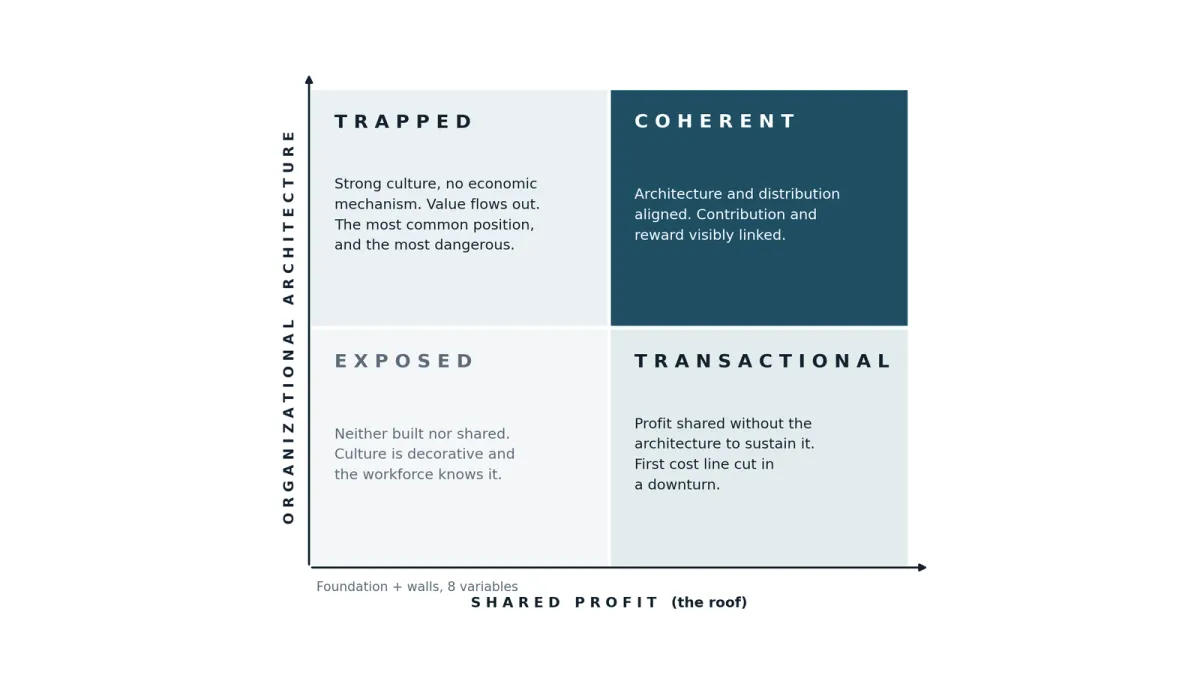
The companies most exposed to the next workforce crisis are not the ones with bad culture. They are the ones with good culture and no mechanism to lock it in.
That inverts almost everything management has been told for thirty years. Invest in culture. Measure engagement. Develop your leaders. Build the employer brand. All of it is sound advice. And all of it, done well and left unfinished, destroys trust faster than neglect ever did.
I call that position Trapped. In my work with leadership teams it is the most common place a company sits, and it is the most dangerous.
Why good culture makes it worse
Culture work does one thing above everything else. It teaches people to pay attention.
An engagement survey asks employees to assess whether they are valued. A values programme asks them to judge decisions against a published standard. A town hall invites them to compare what leadership says with what leadership does. Every one of those is a training exercise in noticing the relationship between contribution and reward.
Then the annual results answer the question.
A company with weak culture never asks. Its people expect a transaction and get one. The distance between promise and distribution stays small because the promise was small. A company with strong culture and no distribution mechanism makes that same distance enormous, and it has spent years teaching its workforce precisely where to look.
This is the culture-value gap: the distance between what an organisation’s culture produces and what its economic model returns to the people who produced it.
It is not a morale problem. It is a capital allocation problem, and it belongs on the CFO’s desk rather than the HR director’s. Every quarter in which the value created by cultural investment flows entirely to external shareholders is a quarter in which your own people receive evidence that the culture is decorative. They do not need a manifesto to reach that conclusion. They need a payslip and a set of published results.
Liability is the right word, and it is worth taking literally rather than loosely. Culture investment creates an obligation. You have told people their contribution matters. You have measured whether they feel valued. You have trained them to check. That is a claim against future profit, incurred the moment you made it and carried off the books ever since. Unrecognised, unfunded, and unranked. Shared Profit is simply the decision to put it on the balance sheet and give it a place in the queue.
The evidence says the parts only pay when they are joined
Analysis of US Census establishment micro-data covering 6,200 employee-owned establishments estimates that adopting employee share ownership raises labour productivity by 5.6 to 6.7 percent.
The same study finds the effect reaches 12.98 percent when ownership is combined with broad-based group performance pay.
Read that twice. The combination roughly doubles either component acting alone. That is not a footnote. That is the entire argument.
The pattern repeats wherever you look. A meta-regression of 355 estimates from 56 studies finds profit sharing positively related to productivity, and concludes that it works best in combination with capital investment and employee participation in decisions. Across 1,782 listed companies and roughly a million employee surveys, a one-point rise in average employee happiness tracks a 1 to 1.2 percentage point increase in return on assets. Psychological safety correlates at .43 with task performance across 136 studies covering some 22,000 employees.
Every one of these is normally sold as a standalone intervention. None of them is. What the research keeps finding, in different countries with different methods, is that the components underperform alone and compound when joined.
That is why the model is a house and not a list.
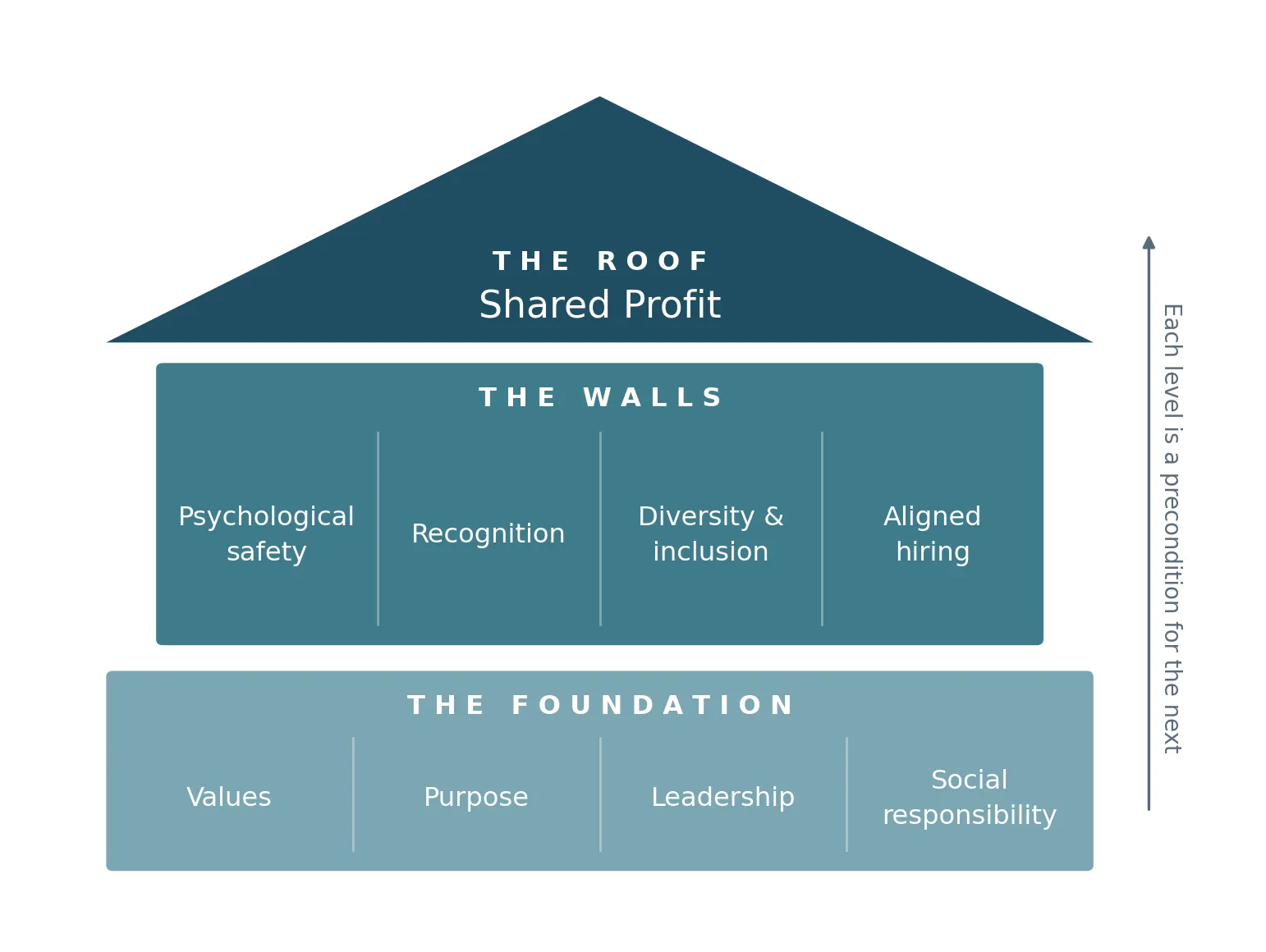
Foundation. Values, purpose, leadership, social responsibility.
Walls. Psychological safety, recognition, inclusion, aligned hiring.
Roof. Shared profit.
Each level is a precondition for the one above. And a house without a roof is not a partly finished house. It is an uninhabitable one. People build it, and never move in.
You have already made the choice. Your people watched you make it.
Here is where most treatments of this subject go soft. They recommend sharing a meaningful percentage of profit and leave it there. A percentage is not a decision. It is a number you can revise.
The decision is about order, not amount.
In the conventional structure, profit covers debt and reinvestment, then dividends and buybacks, and whatever survives that sequence funds a discretionary bonus pool. Employees are paid from the remainder. In a weak year there is no remainder, which is precisely the year in which the message lands hardest.
Shared Profit inverts two lines of that waterfall. The employee share is defined in advance and paid before discretionary capital returns, not after them. Capital absorbs the bad year first.
That is a real choice, because it costs something specific, and because undoing it costs more than never having started.
Senior. The employee share ranks ahead of discretionary distribution to shareholders.
You give up the flexibility to protect capital returns in a weak year.
Pre-committed. The share is defined in writing, in advance, for a multi-year period.
You give up the option to withdraw it when margins compress, which is exactly when you will most want to.
Universal. The scheme states explicitly who it covers, and it covers everyone.
You give up profit sharing as a selective retention tool for individuals you are afraid of losing.
The first objection to this comes from the CFO, and it is a fair one. It has three parts: our covenants, our dividend policy, and the fact that no board can bind its successors.
The first is already answered by where the share sits. It ranks ahead of discretionary distribution to shareholders, not ahead of debt service or the reinvestment the business needs to survive. Lenders are subordinated to no one.
The second and third are really the same objection, and it is correct. There is no instrument that makes this legally irreversible in a company with an annual general meeting. A future board can revoke it. If the business is failing, it should.
So the commitment is not made irreversible. It is made expensive to reverse. You publish the formula, you report against it in the annual accounts, and you state the review cycle in advance. Withdrawal then requires a public explanation to the people who produced the profit, in a document your competitors and your candidates also read.
That is a weaker guarantee than a contract, and a stronger signal than one. A commitment you could not break would tell your workforce nothing about your intentions. One you can break, and visibly do not, tells them everything. The cost of reversal is the whole content of the promise.
The alternative is not nothing. The alternative is the discretionary bonus pool: residual, selective, and cuttable. It is cheaper, most companies have it, and it does not work, because everybody knows it can disappear.
This is also why Trapped is a condition rather than a stage. A company sitting there has not postponed the decision. It has made it, every year, each time it protected the dividend and let the bonus pool absorb the shortfall. The workforce has watched that decision get made repeatedly. Good culture simply gives them the vocabulary to describe what they saw.
I have written elsewhere that stakeholder capitalism fails because it asks leaders to balance interests without specifying how trade-offs are resolved. This is the answer to my own objection. The trade-off is not resolved by judgement, case by case, in the room. It is resolved by seniority, fixed in advance. That is the difference between a value and a bylaw.
The Nordic model solved half of this, and left the other half open
Norwegian and Swedish executives tend to assume this argument is aimed at someone else. American inequality, American pay ratios, an American problem. It is worth remembering what our own settlements actually did, and what they deliberately did not do.
Denmark reached the September Compromise in 1899. Norway signed Hovedavtalen in March 1935. Sweden concluded the Saltsjöbaden Agreement in December 1938. In each case the employers’ confederation entered voluntarily, and in each case for the same unsentimental reason: controlled sharing had become cheaper than uncontrolled loss.
Those agreements settled procedure and recognition. How conflict is resolved. Who has standing at the table. What obligations each side owes the other.
They did not settle ownership. Not one krone of equity changed hands.
Sweden then tried to close that half by legislation, and the attempt is the most instructive failure in Nordic economic history. Rudolf Meidner published his wage-earner fund proposal in 1975 and LO adopted a revised version in 1976: a gradual, statutory transfer of corporate equity into worker-controlled funds. It is the purest form of the argument I am making here.
It failed completely. A heavily diluted version passed in 1983 and operated from 1984 as five regional funds, barred from holding 8 percent or more of the votes in any listed company. At least 75,000 people marched through Stockholm against them on 4 October 1983, one of the largest business-backed mobilisations in Swedish history. Carl Bildt’s government abolished the funds in 1991. The assets were liquidated by 1994.
The lesson is not that shared ownership fails. It is that it cannot be imposed on unwilling owners by statute, and that any attempt to do so mobilises capital into a political force that will spend a fortune to defeat it.
Which leaves exactly one route. The remaining half of the Nordic settlement has to be built at company level, by owners who choose it, before anyone else sets the terms.
That is not a moral argument. It is a scheduling argument.
Why the clock is running
The pressure is not hypothetical, and it is not coming from activists.
Gallup puts the cost of low employee engagement at approximately $10 trillion a year, around 9 percent of global GDP. Roughly 40 percent of Gen Z and millennial workers report having turned down an employer or refused an assignment on ethical grounds, and have reported it at that level in every survey from 2023 to 2026. Across OECD countries, 40 percent of citizens report high or moderately high trust in their national government while 43 percent report low or none.
Meanwhile the numbers that produce that mood keep moving. In 1965 a chief executive earned 21 times the typical worker’s pay. In 2024 the ratio was 281 to 1, after peaking at 408 to 1 in 2021. Between 1978 and 2024, CEO realised compensation grew 1,094 percent against 26 percent for typical worker pay. Global billionaire wealth has more than doubled since 2020, from $8 trillion to $20.1 trillion, gaining $4 trillion in the last twelve months alone.
One honest qualification, because the counter-argument is a single search away. Measured globally, inequality has fallen. The World Bank’s global Gini index dropped from about 70 in 1990 to 62 in 2019 as poorer countries grew faster than rich ones, and that convergence lifted more people out of poverty than any deliberate policy in history. The burden of it landed on workers inside the rich democracies, where inequality moved the other way. Within-country inequality has gone from 43 percent of total global inequality in 1980 to 68 percent in 2020.
That shift, and the politics it has produced inside our own economies, is what a board should be planning around.
Two guardrails, learned the hard way
Employee ownership is not a guarantee, and anyone selling it as one has not read the field.
On 12 July 1994, United Airlines’ pilots and machinists exchanged wage concessions and work-rule changes for approximately 55 percent of the company. UAL filed for Chapter 11 on 9 December 2002. When it emerged in February 2006 the pre-petition stock, including the employees’ shares, was cancelled with no distribution to holders. They lost the concessions and the equity together.
Mondragon’s founding cooperative, Fagor Electrodomésticos, went bankrupt in 2013 with roughly 5,700 employees. In Spain, 417 worker-members were relocated into other cooperatives within three months and around 1,200 of the 2,093 affected workers were slated for relocation, while some 900 were dismissed. The French and Polish subsidiaries, employing about 3,200 people between them, filed for bankruptcy with no access to that mechanism at all.
The John Lewis Partnership paid no Partner bonus from 2023 through 2025, and restored it at 2 percent in March 2026.
Two rules follow, and they sit alongside the three commitments rather than replacing them.
The share must be additive to a competitive wage, never a substitute for one. United’s employees traded pay for paper. That is not shared ownership. That is an unhedged bet on a single employer, sold as partnership.
It must not concentrate a household’s savings in the company that also pays its salary. When the employer fails, the employee should lose one thing, not three.
The position to be in
Most companies I work with have built a foundation and walls to a standard they can be proud of. Values people can actually use. Managers who are trusted. Recognition that is felt. Hiring that selects for alignment.
And then no roof. Which is to say: they have constructed, at considerable expense, the most legible possible demonstration that the value their people create does not come back to them.
That is the Trapped quadrant. It is not a halfway house on the road to something better. It is a specific and deteriorating condition, and the better your culture is, the faster it deteriorates.
The way out is not another engagement initiative. It is a distribution mechanism that is senior, pre-committed and universal, adopted before it is demanded, and set at a level you can defend out loud.
A prediction, so this can be checked rather than admired.
By 2035, at least ten of the fifty largest Nordic listed companies will publish an employee profit share that is pre-committed and ranks ahead of discretionary distribution to shareholders. Not a bonus scheme, and not a good intention in a sustainability report. A stated claim on profit, disclosed in the annual accounts, with shareholders behind it in the queue.
The mechanism is not conscience. It is the labour market. The people who generate the revenue increasingly know that they generate it, and they are increasingly able to price that knowledge. Every culture programme of the last twenty years has trained them to examine the relationship between what they contribute and what they receive. They will not unlearn it. The companies that answer the question first will recruit from the ones that do not.
I think the voluntary route is still open. That is the whole reason for writing this. If I am wrong, the conclusion will not be that the idea was impractical. It will be that owners were given another decade to settle this on their own terms and declined, and that it was then settled on someone else’s.
Whether that happens is not really a question about frameworks. Meidner published his proposal half a century ago. It was defeated, comprehensively, and nothing about the problem it addressed was resolved by defeating it. The question has simply been waiting, and it has been waiting inside profitable, well-run, decently led companies.
The people who will decide how it gets answered are already on the payroll. Most of them are under forty. They have watched every distribution decision this company has made in their working lives, and they were not persuaded by the engagement survey.
Owners have rarely surrendered value without pressure. The ones who came through it moved while the choice was still theirs.
Sources for every figure in this article, with the exact quoted sentence from each publisher, are set out in the accompanying white paper. Principal sources: Gallup, State of the Global Workplace 2026; Kurtulus et al., US Census establishment micro-data, 2026; Doucouliagos, Laroche, Kruse and Stanley, British Journal of Industrial Relations, 2020; De Neve, Kaats and Ward, University of Oxford, 2023; CIPD evidence review, 2024; Deloitte Gen Z and Millennial Survey 2026; OECD Trust Survey 2026; Economic Policy Institute, CEO Pay, 2025; Forbes World’s Billionaires List 2020 and 2026; World Bank Atlas of the SDGs 2023; World Inequality Report 2022; Westerberg, Enterprise & Society, 2023; UAL Corporation SEC filings; Eurofound European Restructuring Monitor.