The Cost of Inaction
The companies most vulnerable to the next workforce crisis are not the ones with bad culture. They are the ones with good culture and no mechanism to lock it in.
This is the central paradox of modern capitalism: organizations invest millions in engagement surveys, leadership development, and employer branding, then distribute the overwhelming majority of the value those efforts create to shareholders who contributed none of the cultural work. The result is predictable. Gallup estimates that low employee engagement cost the world economy approximately $10 trillion in lost productivity last year, around 9 percent of global GDP, covering the roughly 80 percent of workers who are not engaged or actively disengaged. Not because companies lack values statements, but because employees can see the gap between what is professed and what is shared.
For a century, this worked. Capital was scarce, labor was abundant, and the implicit social contract was simple: show up, perform, get paid. That contract is now broken, not by activists or regulators, but by structural economic forces. When the world’s billionaires hold $1.5 trillion more than the combined wealth of the poorest 4.1 billion people, the system’s legitimacy is not under academic debate. It is under existential pressure.
One caveat belongs here, because honest argument requires it and because the counter-evidence is a single search away. Measured globally, inequality has fallen. The World Bank’s global Gini index dropped from around 70 in 1990 to 62 in 2019 as poorer countries grew faster than rich ones, and that convergence lifted more people out of poverty than any deliberate policy in history. But the burden of it fell on workers inside the rich democracies, where inequality moved the other way. The OECD average Gini rose from 0.29 in the mid-1980s to 0.316 by the late 2000s, increasing in 17 of the 22 countries with comparable data, and within-country inequality has gone from 43 percent of total global inequality in 1980 to 68 percent in 2020. It is that shift, and the politics it has produced inside our own economies, that this article is about.
History teaches a consistent lesson: economic systems do not collapse because they stop producing wealth. They collapse when people stop believing they work. And belief is eroding not among idealists, but among the workforce itself. When roughly 40 percent of Gen Z and millennial workers report having rejected an assignment, a project or a potential employer on the basis of their personal ethics, and have reported it at that level in every survey from 2023 to 2026, the talent market is delivering its verdict. But talent flight is only the first stage.
The deeper risk is structural conflict. When 3,428 people hold more wealth than the poorest 4.1 billion combined, the gap between those who create value and those who capture it becomes impossible to ignore. We are already seeing the early signs. In 2023, more major work stoppages began in the United States than in any year since 2000, involving 458,900 workers. The three political groups to the right of the European People’s Party now hold 187 of the European Parliament’s 720 seats, just over a quarter, up from roughly a fifth in 2019. Movements on both left and right share one common target, the concentration of wealth without accountability.
History is unambiguous on what happens next. Owner classes have rarely surrendered wealth without pressure, and the ones that survived learned the lesson before it was forced on them: share voluntarily, or lose involuntarily. The French aristocracy learned it in 1789. American business fought the New Deal rather than conceding it, funding the Liberty League to defeat Roosevelt and losing, and the settlement it was forced to accept became the foundation of thirty years of profitable growth. The Nordic model was built on the same insight through the September Compromise in Denmark in 1899, Hovedavtalen in Norway in 1935, and the Saltsjobaden Agreement in Sweden in 1938: controlled sharing is cheaper than uncontrolled loss. Shared Profit is not idealism. It is the rational response of owners who understand that the alternative to sharing value is losing it entirely.
The conventional response is ESG: measure, report, brand. The backlash against ESG in the U.S. has exposed what serious practitioners always knew, that cosmetic sustainability without structural change is worse than doing nothing. If capitalism is to renew itself, it needs more than reporting frameworks. It needs a structural model that connects identity, culture, and economics into a single system. That is what this article proposes.
What Capitalism 2.0 Really Means
The dominant management response to inequality, disengagement, and climate risk has a name: stakeholder capitalism. Since the Business Roundtable’s 2019 declaration that corporations should serve all stakeholders, not just shareholders, the term has become the default framework for enlightened business leadership. It is also, in its current form, intellectually bankrupt.
Stakeholder capitalism as practiced is a declaration without a mechanism. It asks leaders to balance stakeholder interests without specifying how trade-offs are resolved, how value is measured across constituencies, or, critically, how profit is distributed. The independent evidence is unflattering. Bebchuk and Tallarita hand-collected more than 600 governance documents from 128 signatory companies and found that most retained shareholder-primacy guidelines, that 57 companies explicitly reaffirmed shareholder primacy in updates made after the Statement, and that none conceded the Statement required any change. A difference-in-differences study covering 2004 to 2022 found signatories engage in higher levels of tax avoidance than other US listed firms and have not adjusted that behaviour since 2019. The declaration was not a commitment. It was a press release.
Capitalism 2.0 is not stakeholder capitalism with better marketing. It is a structural alternative.
Where stakeholder capitalism asks who should we consider, Capitalism 2.0 asks how must we build. The difference is architectural, not rhetorical.
The architectural ambition itself is not new. Porter and Kramer’s Creating Shared Value made the case that companies must address societal needs through their core business, not alongside it. Capitalism 2.0 builds on that foundation and extends it into the question Porter left open: how value created inside the firm is distributed between capital and labor.
The evidence supports structure over sentiment. Purpose and wellbeing drive performance. Analysis of roughly one million employee survey responses across 1,782 listed companies finds that a one-point rise in average employee happiness is associated with a 1 to 1.2 percentage point increase in return on assets and a Tobin’s Q higher by 0.30 to 0.34. That is a descriptive association, not a causal estimate. Profit-sharing works. Analysis of US Census establishment micro-data covering 6,200 employee-owned establishments estimates that adopting employee share ownership raises labor productivity by 5.6 to 6.7 percent, and by 12.98 percent when combined with broad-based group performance pay. UK data on employee-owned businesses shows an 8 to 12 percent productivity advantage measured by gross value added per employee. But these are not isolated tactics. They are elements of a system, and they only work when the system is coherent.
The honest reading of that evidence has a limit, and it is worth naming before someone else names it for me. Firms that adopt profit-sharing are often already profitable, already growing, and already run low-conflict labor relations, which makes causation hard to separate from selection. The most careful synthesis available, a meta-regression of 355 estimates drawn from 56 studies, finds profit-sharing positively related to productivity on average and stronger where unionisation is higher, but concludes that it works best in combination with capital investment and employee participation in decisions. That is not a weaker result than the headline. It is the same result the house describes: the roof only holds when it sits on walls.
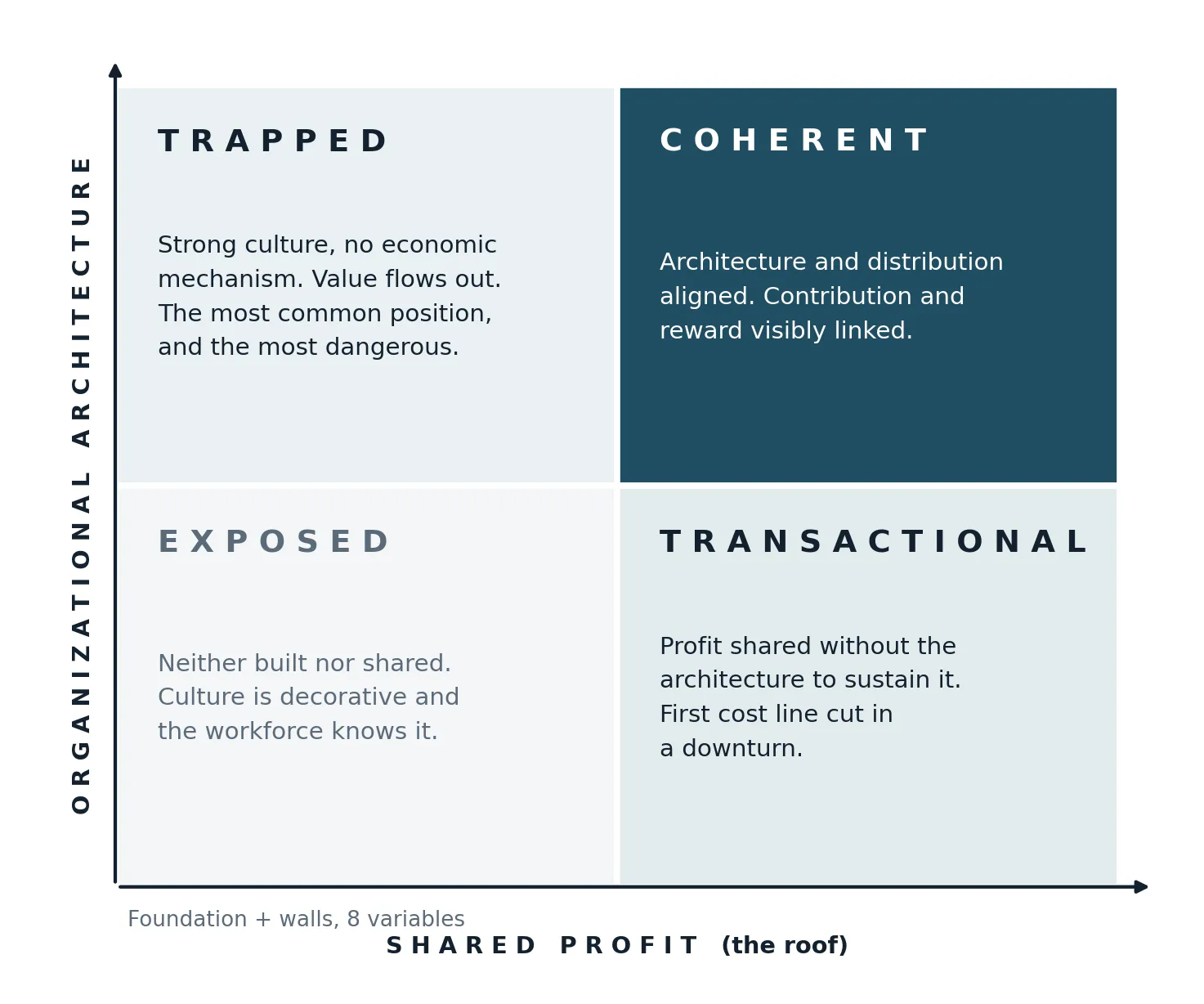
That coherence is what the Shared Profit framework provides. It is a structural model, a house where each level depends on and reinforces the others. Without that architecture, purpose becomes platitude, culture becomes fragile, and profit-sharing becomes a cost line that gets cut in the next downturn.
In my work advising companies over the past decade, I have observed a pattern I call the culture-value gap: the distance between what an organization’s culture produces and what its economic model distributes back to the people who produced it. Where contribution and reward are visibly linked, high performers stay and strategy executes. Where they are not, leaders get the pattern every executive recognizes: strong engagement scores that mysteriously fail to translate into sustained performance.
The culture-value gap is not a morale problem. It is a capital allocation problem. Every quarter that value created by cultural investment flows entirely to external shareholders is a quarter where the organization’s own people receive evidence that the culture is decorative, not structural. The Shared Profit framework was built to close this gap systematically, from foundation to roof.
Liability is the right word for this, and it is worth taking literally rather than loosely. Culture investment creates an obligation. You have told people their contribution matters. You have measured whether they feel valued. You have trained them to check. That is a claim against future profit, incurred the moment you made it and carried off the books ever since. Unrecognised, unfunded, and unranked. Shared Profit is simply the decision to put it on the balance sheet and give it a place in the queue.
A Model for Renewal: The Shared Profit House
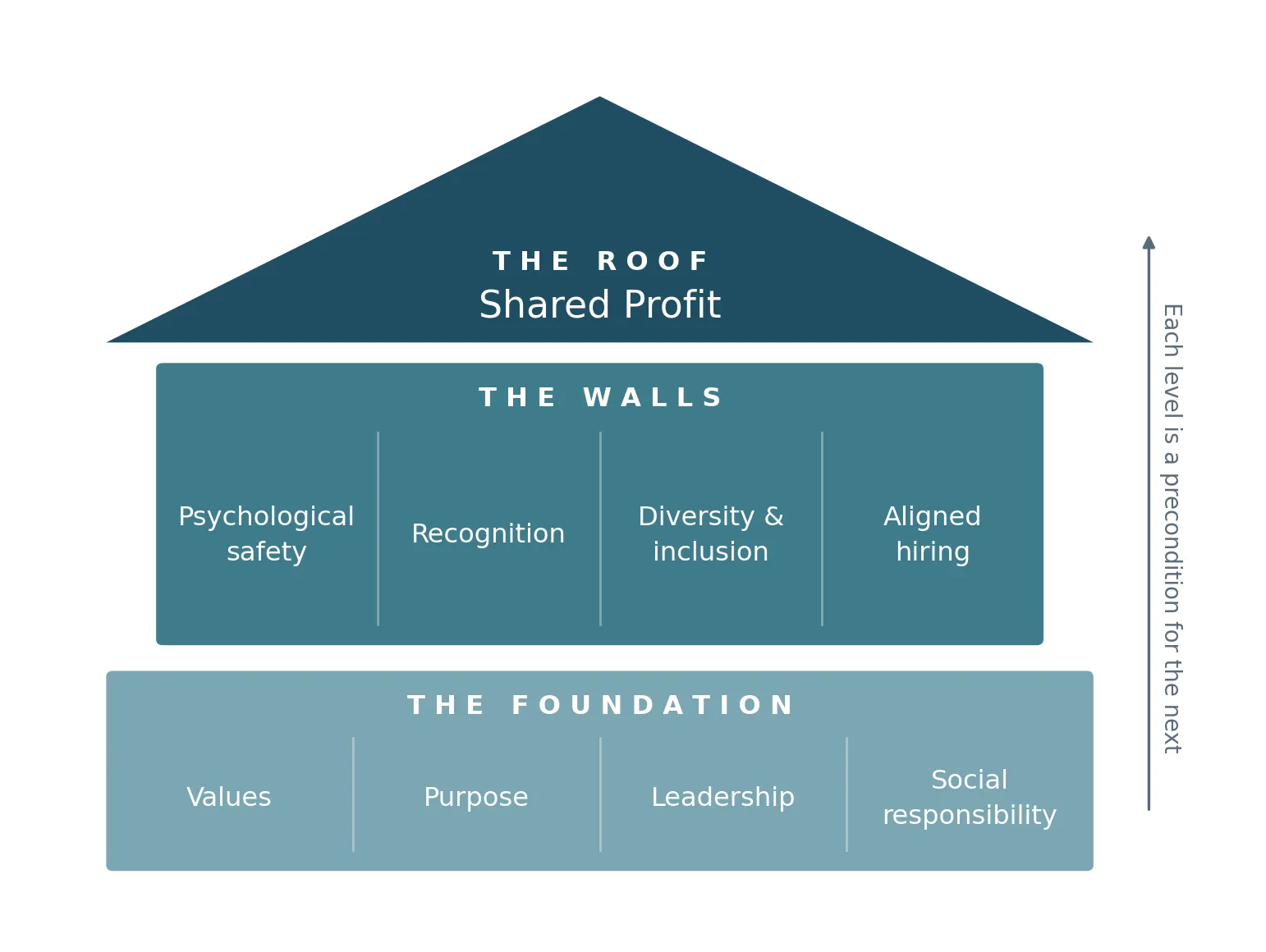
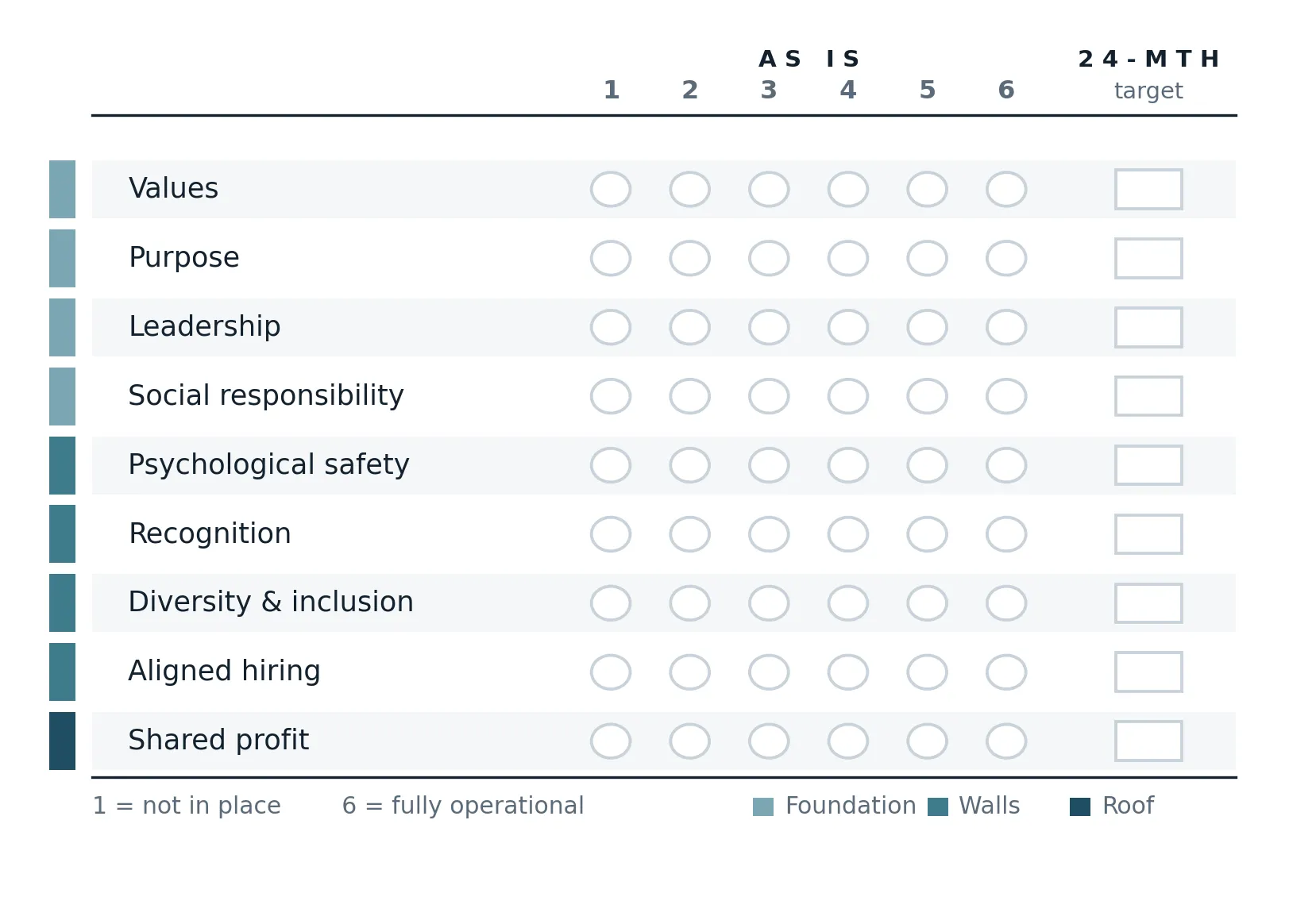
The framework is built around a simple metaphor: a house. But the metaphor carries structural logic. You cannot build walls on a weak foundation, because culture collapses without identity. You cannot put on a roof without walls, because profit-sharing fails without the cultural infrastructure to sustain it. And without a roof the house stands unfinished: people build, but never move in. Each level is a precondition for the next.
The Foundation
The foundation defines identity and long-term direction: who are we, why do we exist, and how do we lead? If the foundation is performative, the house falls from the bottom up.
Values must be operational, not aspirational. The test: can a frontline manager use the stated values to resolve a dilemma without escalation? If not, the values are wallpaper. In my experience advising leadership teams across industries, very few companies pass.
Purpose is where Capitalism 2.0 lives or dies, and where most companies must change first. The dominant corporate purpose today, whether stated or implicit, is shareholder return maximization. Mission statements decorate that purpose without altering it. That is precisely what no longer works. Capitalism 2.0 requires that companies redefine why they exist, not how they communicate it. The change is substantive, not editorial. Inequality and climate are not separate crises that companies must address alongside their business. They are downstream symptoms of a purpose deficit. Without a redefined purpose that constrains what the business will and will not do, values are aesthetics, leadership is management, social responsibility is reporting, and profit sharing is bonus structure.
A new purpose must therefore be specific and falsifiable, because it is what gives profit its legitimacy. Making the world a better place is a platitude, not a purpose. A genuine purpose creates strategic constraints: it tells you what you will not do. The test is not what you stand for. It is which revenue you refuse, named, this year. What the owner gives up at this level is turnover, in the current accounts, measurably. Patagonia adopted We’re in business to save our home planet in 2018, and in December 2017 the company had already joined legal action against the Trump administration over the reduction of national monuments. Most company purpose statements would not survive a board meeting where they conflicted with quarterly targets. Closing that gap is the core of Capitalism 2.0.
Leadership must combine competence with clarity and courage. In the context of Capitalism 2.0, leaders must do three things that most find uncomfortable: reward employees fairly even when short-term margins suffer, communicate direction transparently even when the path is uncertain, and redesign business models even when the current model still generates profit. The symbolic power of leadership actions is underestimated in strategy and overestimated in HR. When a CEO takes a pay cut during a downturn while maintaining profit-sharing, that signal travels through the organization faster than any town hall. When they don’t, that signal travels even faster.
Social responsibility must move from annual reports to operating budgets. Responsibility as reputation management is fragile: it collapses at the first sign of ESG backlash. Responsibility as value creation is antifragile, embedded in operations, not communications.
The Walls
The walls represent the cultural infrastructure that translates identity into daily performance. They can only stand on a solid foundation. Psychological safety requires trustworthy leadership, genuine recognition requires authentic values, inclusion requires a purpose worth including people in. Without the foundation, the walls are theatre. With it, they are load-bearing.
Google’s Project Aristotle, a study of 180 teams, identified psychological safety as by far the most important of five factors in team effectiveness. The finding has since been replicated at scale: a meta-analysis of 136 studies covering roughly 22,000 employees across some 5,000 groups finds a correlation of .43 between psychological safety and task performance in the studies that measured it. Predictability, healthy work-life integration, and freedom from fear are not soft benefits. They are performance infrastructure.
Gallup finds that employees who strongly agree recognition is an important part of their organization’s culture are 3.7 times as likely to be engaged, and that well-recognized employees are 45 percent less likely to have left two years later. Recognition costs almost nothing and returns almost everything.
Psychological safety is not, however, monotonically good, and the qualification matters more than it first appears. Field research across five studies finds an inverted-U relationship with in-role performance: moderate safety improves it, high safety without collective accountability degrades it, particularly on routine work. Safety without consequence becomes comfort. What the owner gives up at this level is the comfort of a culture everyone likes, because safety has to be paired with shared accountability for the result, and some people will find that unwelcome.
Diversity without inclusion is recruitment without retention. Inclusion means diverse perspectives influence decisions, not just that diverse people are present.
Hiring must optimize for alignment as much as competence. Recruit for purpose and values, not just skills.
The Roof: Shared Profit
At the top of the model sits the element that completes the structure. The roof is not a reward for building well. It is what makes the building habitable. Without shared profit, the house stands open to the sky: impressive in blueprint, uninhabitable in practice.
Here is where most treatments of this subject go soft. They recommend sharing a meaningful percentage of profit and stop there. A percentage is not a decision. It is a number that can be revised in any board meeting. The decision is about order, not amount.
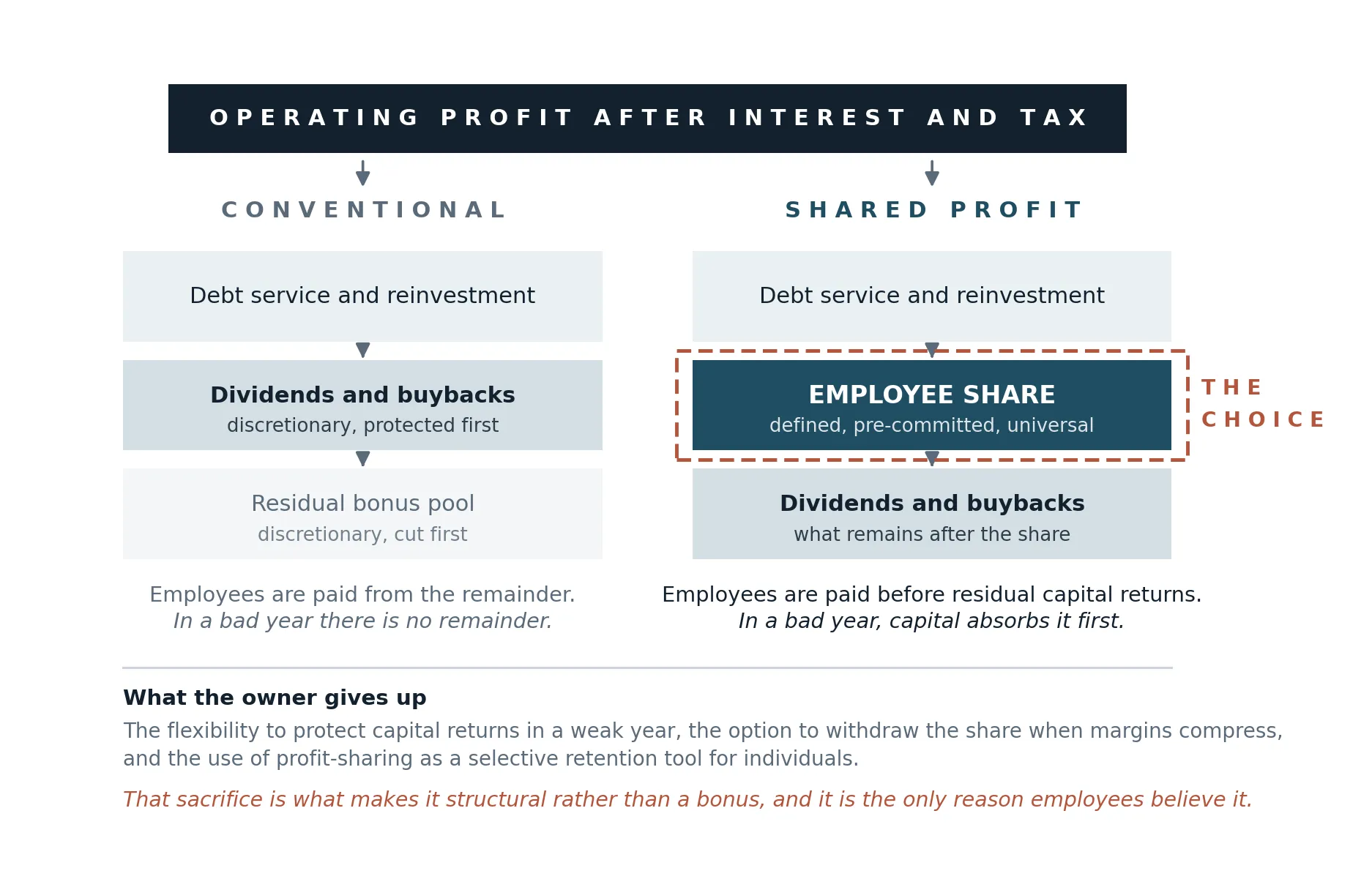
In the conventional structure, profit covers debt service and reinvestment, then dividends and buybacks, and whatever survives that sequence funds a discretionary bonus pool. Employees are paid from the remainder. In a weak year there is no remainder, which is precisely the year in which the message lands hardest.
Shared Profit inverts two lines of that waterfall. The employee share is defined in advance and paid before discretionary capital returns, not after them. Capital absorbs the bad year first. That is a real choice, because it costs something specific, and because undoing it costs more than never having started.
Senior. The employee share ranks ahead of discretionary distribution to shareholders. The owner gives up the flexibility to protect capital returns in a weak year.
Pre-committed. The share is defined in writing, in advance, for a multi-year period. The owner gives up the option to withdraw it when margins compress, which is exactly when the temptation is greatest.
Universal. The scheme states explicitly who it covers, and it covers everyone. The owner gives up profit-sharing as a selective retention tool for individuals.
The first objection to this comes from the CFO, and it is a fair one. It has three parts: our covenants, our dividend policy, and the fact that no board can bind its successors.
The first is already answered by where the share sits. It ranks ahead of discretionary distribution to shareholders, not ahead of debt service or the reinvestment the business needs to survive. Lenders are subordinated to no one.
The second and third are really the same objection, and it is correct. There is no instrument that makes this legally irreversible in a company with an annual general meeting. A future board can revoke it. If the business is failing, it should.
So the commitment is not made irreversible. It is made expensive to reverse. You publish the formula, you report against it in the annual accounts, and you state the review cycle in advance. Withdrawal then requires a public explanation to the people who produced the profit, in a document your competitors and your candidates also read.
That is a weaker guarantee than a contract, and a stronger signal than one. A commitment you could not break would tell your workforce nothing about your intentions. One you can break, and visibly do not, tells them everything. The cost of reversal is the whole content of the promise.
The alternative is not nothing. The alternative is the discretionary bonus pool: residual, selective and cuttable. It is cheaper, most companies have it, and it does not work, because everybody knows it can disappear.
This is also the answer to the objection I raised against stakeholder capitalism at the start of this paper. Its failure was that it asked leaders to balance interests without specifying how trade-offs are resolved. Here the trade-off is not resolved by judgement, case by case, in the room. It is resolved by seniority, fixed in advance. That is the difference between a value and a bylaw.
It also explains why Trapped is a condition rather than a stage. A company sitting there has not postponed the decision. It has made it, every year, each time it protected the dividend and let the bonus pool absorb the shortfall. The workforce has watched that decision get made repeatedly. Good culture simply gives them the vocabulary to describe what they saw.
Shared Profit acknowledges a structural truth: companies thrive when employees thrive, and employees thrive when value is shared. This is not philanthropy. It is structural economics. It recognizes value creation as a collective effort and rewards it accordingly.
The evidence is clear. US Census micro-data estimates that employee share ownership raises labor productivity by 5.6 to 6.7 percent, rising to 12.98 percent when combined with broad-based performance pay. Employee-owners hold median household wealth 45 percent higher and median income 23 percent higher than comparable non-owners, and stay roughly three years longer. Across European firms, employee financial participation schemes are associated with improvements in both labor productivity and employment. The John Lewis Partnership, held in trust for its Partners rather than owned by external shareholders, ranked second across all UK sectors and first in retail in the July 2026 UK Customer Satisfaction Index. Mondragon Corporation, a federation of 81 cooperatives with group-wide employment of around 71,000, not all of them worker-members, has for its worker-members consistently prioritised redeployment across cooperatives over redundancy. These are not experiments. They are working models operating at scale.
They are proof of concept, not proof of immunity, and the failures teach more than the successes. On 12 July 1994, United Airlines’ pilots and machinists exchanged wage concessions and work-rule changes for approximately 55 percent of the company’s equity and voting power. UAL filed for Chapter 11 on 9 December 2002, and when it emerged in February 2006 the pre-petition stock, including the employees’ ESOP shares, was cancelled with no distribution to holders. They lost the concessions and the equity together. Mondragon’s founding cooperative, Fagor Electrodomesticos, went bankrupt in 2013 with roughly 5,700 employees across thirteen sites. In Spain, 417 worker-members had been relocated into other cooperatives within three months and around 1,200 of the 2,093 affected workers were slated for relocation, while some 900 were dismissed. The French and Polish subsidiaries, employing about 3,200 people between them, filed for bankruptcy with no access to that mechanism at all. John Lewis paid no Partner bonus from 2023 through 2025 and restored it at 2 percent only in March 2026.
Two guardrails follow from those cases, and they sit alongside the three commitments rather than replacing them. An employee stake must be additive to a competitive wage, never a substitute for one. United’s employees traded pay for paper, and that is not shared ownership; it is an unhedged bet on a single employer, sold as partnership. And the stake must not concentrate a household’s savings in the same company that pays its salary. When the employer fails, the employee should lose one thing, not three.
Shared Profit is the economic expression of values and purpose. It is the roof not because it protects, but because it completes. Without it, the house stands unfinished: strong foundation, solid walls, but no one moves in. Shared profit is what makes the structure worth inhabiting, the signal that the value people create comes back to them.
What Owners and Leaders Must Do Now
Before the shifts, one lesson about method, and it comes from the country most often held up as proof that sharing works. Rudolf Meidner published his wage-earner fund proposal in 1975 and LO adopted a revised version in 1976: a gradual, legislated transfer of corporate equity into worker-controlled funds. It is the purest version of the argument in this article, and it failed. A heavily diluted version passed in 1983 and operated from 1984 as five regional funds, financed by a tax on excess profits and barred from holding 8 percent or more of the votes in any listed company. At least 75,000 people marched through Stockholm against them on 4 October 1983, one of the largest business-backed mobilisations in Swedish history. Carl Bildt’s government abolished the funds in 1991, and the assets were liquidated by 1994.
The lesson is not that shared ownership fails. It is that it cannot be imposed on unwilling owners by statute. It has to be built at firm level, by owners who choose it, before the state chooses for them. That is precisely the window this article argues is closing, and it is why every shift below is a decision for a board, not a demand on a parliament.
The path forward requires four structural shifts. Not incremental adjustments, but redesign decisions that change how the organization operates.
First, redefine purpose as a strategic filter. Purpose must constrain capital allocation and product decisions, not just inspire posters. The test is simple: what would you stop doing if you took your purpose seriously?
Second, translate values into decision protocols. If values cannot be used by a frontline manager to resolve a dilemma without escalation, they are not operational. Build decision trees, not declarations.
Third, lead with visible fairness. In 2023, median CEO pay at the 100 largest STOXX 600 companies was 4.15 million euro, roughly 110 times the average EU worker’s salary of 37,863 euro. Benchmark your own company-level ratio, disclose it, and narrow it.
Fourth, make the employee share senior, pre-committed and universal. Pay it ahead of discretionary distribution to shareholders, define it in writing for a multi-year period, and state explicitly that it covers everyone. The percentage is secondary and can be argued about. The ordering is the decision, and it is the only part your workforce cannot misread.
The Choice: Why There Is No Alternative
Capitalism will not renew itself. It will be renewed by owners and leaders who choose to operate differently, or it will be disrupted by forces far less friendly to enterprise and innovation. The history of economic systems is unambiguous on this point: when concentration becomes extreme and the social contract breaks, what follows is not gradual reform. It is rupture.
This is not a call for generosity. It is a diagnosis.
The math is no longer debatable. In 1965, a CEO earned 21 times the typical worker’s pay. In 2024, the ratio was 281 to 1, after peaking at 408 to 1 in 2021. Between 1978 and 2024, CEO realized compensation grew by 1,094 percent while typical worker pay grew by 26 percent. Global billionaire wealth has more than doubled since 2020, from $8 trillion across 2,095 billionaires to $20.1 trillion across 3,428, a gain of $4 trillion in the last twelve months alone. Real wages in advanced G20 economies fell for two consecutive years, by 2.8 percent in 2022 and 0.5 percent in 2023, and have only partly recovered. European real wages, though growing again since 2024, are still around 0.7 percent below their 2019 level, and the global labor income share is lower today than in 2004, having dropped a further 0.6 percentage points between 2019 and 2022 and stayed flat since, a gap worth $2.4 trillion of foregone labor income in 2024 alone.
This is not a political argument. It is a structural observation. No economic system has held this degree of concentration without being forced to change. Rome, the feudal monarchies and the Gilded Age each reached the point where the settlement was rewritten, by revolution, by collapse, or in the American case by regulation. The mechanism varies. The rewriting does not. When the many stop believing the system works for them, the system stops working.
We are already there. Across OECD countries, only 40 percent of citizens report high or moderately high trust in their national government, while 43 percent report low or no trust. In the United States, the share of adults with a positive image of capitalism has fallen to 54 percent, the lowest Gallup has ever recorded, and of big business to 37 percent, the lowest since that series began in 2010. Populist movements on both the left and right are gaining ground, and their shared target is not government. It is concentrated private wealth without accountability. When France’s gilets jaunes burned fifteen motorway interchanges and toll plazas in 2018, causing tens of millions of euros of damage, and American workers staged more major work stoppages in 2023 than in any year since 2000, they were not demanding charity. They were serving notice.
The question is not whether capitalism will be reformed. It will be, either by owners who act now or by forces that act later on far worse terms. Regulation, forced redistribution, talent exodus, social instability: these are not distant risks. They are the default trajectory.
The Shared Profit framework is not an aspiration. It is an insurance policy, the structural mechanism through which owners can redistribute enough value to preserve the system that created their wealth. The alternative is not the status quo. The alternative is that someone else decides how much you share, and when, and with whom.
A prediction, so this can be checked rather than admired.
By 2035, at least ten of the fifty largest Nordic listed companies will publish an employee profit share that is pre-committed and ranks ahead of discretionary distribution to shareholders. Not a bonus scheme, and not a good intention in a sustainability report. A stated claim on profit, disclosed in the annual accounts, with shareholders behind it in the queue.
The mechanism is not conscience. It is the labour market. The people who generate the revenue increasingly know that they generate it, and they are increasingly able to price that knowledge. Every culture programme of the last twenty years has trained them to examine the relationship between what they contribute and what they receive. They will not unlearn it. The companies that answer the question first will recruit from the ones that do not.
I think the voluntary route is still open. That is the whole reason for writing this. If I am wrong, the conclusion will not be that the idea was impractical. It will be that owners were given another decade to settle this on their own terms and declined, and that it was then settled on someone else’s.
Whether that happens is not really a question about frameworks. Meidner published his proposal half a century ago. It was defeated, comprehensively, and nothing about the problem it addressed was resolved by defeating it. The question has simply been waiting, and it has been waiting inside profitable, well-run, decently led companies.
The people who will decide how it gets answered are already on the payroll. Most of them are under forty. They have watched every distribution decision this company has made in their working lives, and they were not persuaded by the engagement survey.
The companies that move first will not just adapt. They will set the terms. And in a world that is already choosing between renewal and replacement, setting the terms is the only defensible position left.
One last observation, and it is the reason this paper exists.
The shareholder-primacy era is usually dated from around 1980. The postwar settlement it replaced had run for roughly thirty-five years, and very few people inside it in 1975 believed it was ending. Arrangements of this kind do not announce themselves as temporary. They feel permanent until the year they stop.
I am not predicting collapse, and I do not think collapse is the relevant risk. The relevant risk is quieter: that the arrangement keeps producing wealth while steadily losing the consent of the people who produce it, and that owners spend that entire period believing they still have time.
References
All figures in this paper were verified against the primary source cited below in August 2026.
Arbeiderbevegelsens arkiv og bibliotek. Hovedavtalen av 1935, signed 9 March 1935 by Landsorganisasjonen and Norsk Arbeidsgiverforening.
Bebchuk, L. A., & Tallarita, R. (2022). Will Corporations Deliver Value to All Stakeholders? Vanderbilt Law Review, 75(4), 1031-1091.
Business Roundtable (2019). Statement on the Purpose of a Corporation. 19 August 2019, 181 signatory chief executives.
Capezio, A., Barends, E., Rousseau, D., & Wietrak, E. (2024). Psychological Safety: An Evidence Review. CIPD. (Consolidating Frazier et al., 2017, k = 136.)
CECOP (2014). The Mondragon Corporation has already relocated 417 worker-members from Fagor Electrodomesticos. January 2014.
De Neve, J.-E., Kaats, M., & Ward, G. (2023). Workplace Wellbeing and Firm Performance. University of Oxford Wellbeing Research Centre, Working Paper 2304, 12 May 2023. DOI 10.5287/ora-bpkbjayvk.
Deloitte (2026). Gen Z and Millennial Survey: Progress on Their Own Terms. 22,595 respondents across 44 countries.
Doucouliagos, H., Laroche, P., Kruse, D. L., & Stanley, T. D. (2020). Is Profit Sharing Productive? A Meta-Regression Analysis. British Journal of Industrial Relations, 58(2), 364-395. 355 estimates from 56 studies.
Economic Policy Institute (2025). CEO Pay. September 2025, realized-compensation measure.
Edmondson, A. C., & Bransby, D. P. (2023). Psychological Safety Comes of Age: Observed Themes in an Established Literature. Annual Review of Organizational Psychology and Organizational Behavior, 10, 55-78.
El Ghoul, S., Guedhami, O., & Jamshed, R. (2026). Redefining Purpose: The Effect of the 2019 Business Roundtable Statement on Corporate Tax Strategies. Business Ethics, the Environment & Responsibility, 35(2), 914-929.
Eurofound. European Restructuring Monitor, Fagor Electrodomesticos, announced 30 October 2013. 2,093 workers affected in Spain, 1,603 cooperative members, about 1,200 to be relocated and about 900 dismissed; French and Polish subsidiaries also filed for bankruptcy.
European Commission, DG EMPL (2025). Labour Market and Wage Developments in Europe: Annual Review 2025.
Forbes (2020). Forbes Publishes 34th Annual List of Global Billionaires. 7 April 2020. 2,095 billionaires, $8.0 trillion combined.
Forbes (2026). 2026 World’s Billionaires List: Facts and Figures. 10 March 2026. 3,428 billionaires, $20.1 trillion combined.
Gallup (2025). Image of Capitalism Slips to 54% in U.S. Published 8 September 2025; survey fielded 1-20 August 2025, n = 1,094 US adults.
Gallup (2026). State of the Global Workplace 2026.
Gallup & Workhuman (2023). Empowering Workplace Culture Through Recognition. n = 1,081 US employees, fielded 26 May to 6 June 2023.
Gallup & Workhuman (2024). From Praise to Profits: The Business Case for Recognition at Work. Longitudinal study of approximately 3,500 US employees, 2022 to 2024.
Google re:Work. Understand Team Effectiveness (Project Aristotle). 180 teams.
Hashani, A., Hashi, I., Matiaske, W., Czaya, A., & Lowitzsch, J. (2025). Development of employee financial participation schemes in EU member states and their impact on firm performance: new evidence using European Company Surveys. International Review of Applied Economics, 39(2-3), 331-365.
House of Commons Library (2024). EU elections 2024: Results and the new European Parliament. Research briefing CBP-10068, 31 July 2024.
ILO (2024). Global Wage Report 2024-25. International Labour Office, Geneva.
ILO (2024). World Employment and Social Outlook: September 2024 Update. Labour income share.
Institute of Customer Service (2026). UK Customer Satisfaction Index, July 2026.
John Lewis Partnership. Annual Report and Accounts, 2023 to 2026. Partner Bonus suspended after 2022, reinstated at 2 percent in March 2026.
Kurtulus, F. A., Hoyt, E., Ouimet, P., Blasi, J., Kruse, D., Freeman, R. B., & Castellano, W. (2026). Employee Share Ownership, Management Practices, and Labor Productivity: An Analysis Using Establishment Level Micro-Data from the U.S. Census. Working paper and Rutgers Institute for the Study of Employee Ownership and Profit Sharing policy brief, 29 March 2026. The 12.98 percent combined estimate is reported in the policy brief.
Landsorganisationen i Sverige. The Basic Agreement (Saltsjobadsavtalet), concluded December 1938 between SAF and LO.
Mercer (2024). Board and CEO Remuneration in Europe. 100 largest STOXX 600 organisations.
Mondragon Corporation (2026). Annual results 2025 and corporate profile.
NCEO (2025). Employee Ownership and Economic Well-Being. Analysis of the US Bureau of Labor Statistics National Longitudinal Surveys.
OECD (2011). Divided We Stand: Why Inequality Keeps Rising. OECD Publishing, Paris. Average Gini across OECD countries, mid-1980s to late 2000s.
OECD (2026). Survey on Drivers of Trust in Public Institutions: 2026 Results. Third wave, fielded 2025, published June 2026, covering 33 OECD and 5 accession candidate countries.
Ownership at Work / University of Stirling (2023). People Powered Growth. UK employee-owned businesses.
Oxfam and ITUC (2026). Working for the Rich. Media briefing, 1 May 2026. Billionaire wealth $1.5 trillion above the combined wealth of the poorest 4.1 billion people; 3,428 billionaires; $4 trillion gain over twelve months.
Oxfam International (2026). Resisting the Rule of the Rich: Protecting Freedom from Billionaire Power. January 2026, with Methodology Note.
Patagonia Works et al. v. Trump et al., US District Court for the District of Columbia, filed 6 December 2017, challenging the reduction of the Bears Ears National Monument.
Patagonia. Our Purpose: We are in business to save our home planet. Company statement, purpose adopted 2018.
Porter, M. E., & Kramer, M. R. (2011). Creating Shared Value. Harvard Business Review, January-February 2011.
Rutgers Institute for the Study of Employee Ownership and Profit Sharing. The United Airlines bankruptcy and the future of employee ownership. Terms of the 12 July 1994 ESOP recapitalization.
UAL Corporation. Annual Report on Form 10-K for 2005, US Securities and Exchange Commission. Chapter 11 filing 9 December 2002; pre-petition equity cancelled on emergence, 1 February 2006.
US Bureau of Labor Statistics (2024). Major Work Stoppages in 2023. 33 stoppages, 458,900 workers.
Vinci Autoroutes. Damage assessment of the gilets jaunes protests, reported 17 December 2018: fifteen interchanges and toll plazas burned, damage estimated at several tens of millions of euros.
Westerberg, R. (2020). Socialists at the Gate: Swedish Business and the Defense of Free Enterprise, 1940-1985. Doctoral dissertation, Stockholm School of Economics.
Westerberg, R. (2023). From Marxist Venture to Venture Capitalists: The Swedish Wage-Earner Funds and the Market Turn, 1983-1994. Enterprise & Society, 24(4), 1014-1037.
Wolfskill, G. (1962). The Revolt of the Conservatives: A History of the American Liberty League, 1934-1940. Houghton Mifflin, Boston.
World Bank (2023). Atlas of Sustainable Development Goals 2023, Goal 10: Reduced Inequalities. Global Gini index, 1990 to 2019.
World Inequality Lab (2022). World Inequality Report 2022. Decomposition of within- and between-country inequality, 1980 to 2020.