
For over a century, capitalism has been the most powerful engine for prosperity the world has ever seen. It has lifted millions out of poverty, fueled innovation, and raised living standards across continents. Yet today, the very system that once created stability is showing clear signs of strain. Inequality is at historic levels, climate targets are slipping, and trust in institutions is weakening.
One fact illustrates the severity of the situation:The eight richest men on the planet now own more wealth than the poorest 50% of humanity combined.
No economic system can maintain legitimacy under such conditions. When wealth becomes this concentrated, the fabric of society begins to unravel. History shows that systems do not collapse because they stop producing wealth — they collapse when people stop believing in them. And when employees no longer believe the system benefits them as contributors, trust erodes from within — silently at first. And once that trust falls below a critical threshold, the system loses the very consent it depends on to function.
If capitalism is to survive, it must renew itself. If it does not, it will lose the mandate it depends on. This renewal is what we call Capitalism 2.0, and the key question becomes: How can companies lead this transformation in practical, operational ways?
To answer this, SCG has developed a model we call Developing Shared Vision — a framework that helps leaders realign their companies with societal expectations while strengthening long-term performance.
What Capitalism 2.0 Really Means
Capitalism 2.0 is not a rejection of capitalism, but a necessary upgrade. Profit remains essential, but the legitimacy of profit now depends on how it is created and how it is shared. The world is demanding both prosperity and fairness — not one or the other.
This shift is driven by global pressures that can no longer be ignored. Extreme wealth concentration threatens social cohesion. CO₂ emissions continue to rise despite international commitments. Employees — especially younger generations — expect leaders to take responsibility beyond quarterly results. Research shows that companies with a clear purpose and fair value distribution outperform the market. Profit-sharing increases productivity and reduces internal inequality. And the deeper truth is this: capitalism, in its current form, has reached a point where renewal is not simply desirable — it is unavoidable. The system cannot continue to function under today’s level of inequality and resource pressure. It must evolve, or it will lose the legitimacy that allows it to exist.
Taken together, these forces make one thing clear: renewal is not optional. Capitalism 2.0 is the only viable path forward.
A Model for Renewal: Developing Shared Vision
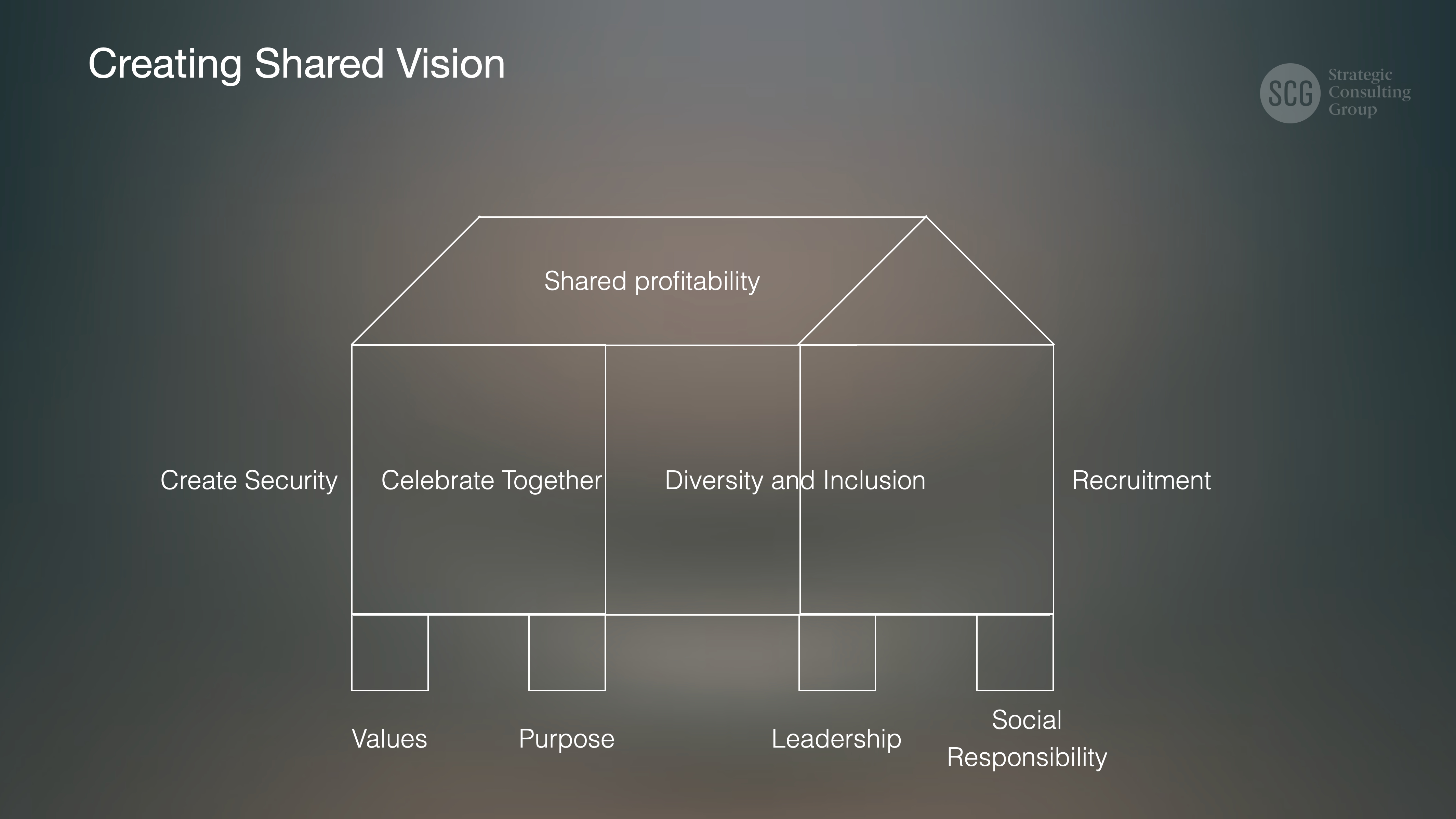
To help leaders translate these macro forces into concrete actions, we present a framework built around a simple metaphor: a house. Like any stable house, the organization needs a solid foundation, strong walls, and a protective roof. Each part represents a dimension that must be strengthened to thrive in the next era of capitalism.
THE FOUNDATION
The foundation consists of the elements that define a company’s identity and long-term direction. If this foundation is weak, no strategy, branding exercise, or financial engineering can create true renewal.
Values
Values must be real, relatable, and consistently practiced. They answer the question: *What do we stand for when no one is watching?*In times of uncertainty, values provide moral clarity. In times of inequality, they create trust. Values are not decoration; they are the grammar of organizational behavior and, increasingly, a strategic advantage.
Purpose
Purpose sits at the core of Capitalism 2.0. It explains why the company exists beyond generating profit and how it contributes to society. A strong purpose inspires employees, drives innovation, shapes long-term thinking, and guides decisions in times of change. Younger generations expect it; investors reward it. A renewed purpose rooted in sustainable value creation may be the most important strategic choice leaders make.
Leadership
Leadership must combine competence with clarity and courage. Modern leaders understand the symbolic power of their actions. They reward employees fairly, communicate direction transparently, and are willing to redesign outdated business models. Leaders who resist renewal risk losing trust. Leaders who embrace it will define the next successful generation of companies.
Social Responsibility
Responsibility must move from communication to execution. A company aligned with Capitalism 2.0 measures its environmental footprint, reduces emissions, aligns with relevant SDGs, and creates value for all stakeholders — not just shareholders. Purpose and responsibility must reinforce each other in practice.
THE WALLS
The walls of the house represent the cultural infrastructure that enables the company to function every day.
Create Security
Employees must feel safe. Predictability, psychological safety, and a healthy work–family–life balance are essential for performance and innovation. Ultimately, employees are the ones who generate revenue and profit.
Celebrate Together
Most companies underestimate the power of recognition. Celebrating progress — whether small or significant — builds culture, reinforces belonging, and strengthens motivation.
Diversity and Inclusion
As societies become more diverse, companies must embrace diversity as a source of strength. Diverse teams make better decisions, create more innovative solutions, and reflect the customers they serve. Inclusion ensures that all voices contribute to growth.
Recruitment
Hiring must support the journey, not hinder it. The most successful companies are those that bring in people who believe in the purpose, embody the values, and have the skills necessary to move the organization forward.
THE ROOF — SHARED PROFIT
At the top of the model sits the principle that completes the structure:Profit must be shared more fairly.
Shared Profit acknowledges a simple truth: companies thrive when employees thrive — and employees thrive when value is shared. This is not philanthropy; it is structural economics. It recognizes value creation as a collective effort.
When employees receive a meaningful share of financial results, internal inequality decreases, loyalty and innovation increase, and the company becomes more resilient. Real-world examples like Patagonia, John Lewis Partnership, and Mondragón demonstrate the long-term power of profit-sharing systems.
Shared Profit is the economic expression of values and purpose. It is the roof that protects and unifies the entire organization.
What Owners and Leaders Must Do Now
The path forward is clear:
- Redefine purpose around sustainable value creation.
- Translate values into real decision-making principles.
- Lead with sincerity, fairness, and courage.
- Adopt profit-sharing structures that reflect collective value creation.
- Align business strategy with measurable societal and environmental outcomes.
This is not a refinement of capitalism; it is its renewal.
Final Reflections
Capitalism will not renew itself.It will be renewed by owners and leaders who choose to operate differently.
The warning signs are unmistakable. When eight men own more wealth than half of the world’s population, the system is not only unfair — it is unstable. Such extreme inequality cannot persist without consequences. If capitalism does not evolve, the social contract that underpins it will break.
Capitalism 2.0 is not an idea of a better system.It is the only path for capitalism to remain viable.
Companies that strengthen every part of the Developing Shared Vision model — foundation, walls, and roof — will build more resilient, equitable, and profitable organizations. Those who take the lead will not only renew their businesses; they will help renew the system itself.
Exercise: Transform Your Business Model
On a 5-point scale from “very poor” to “very good,” evaluate your company across the nine areas of the Developing Shared Vision model. Identify where you want to be in 2–3 years — and create a concrete plan to get there.